Resources & Reports

Newsletter

Senate HELP Committee Offers Helpful Recommendations to FDA

Last week the Senate Committee on Health, Education, Labor & Pensions (HELP) released their report “Patients and Families First: Building the FDA of the Future.”  This report outlines legislative and regulatory reforms that will help update the Food and Drug Administration (FDA).  As noted in the report, advances in technology and medicine have improved or created ways in which to treat various health issues, but various regulatory barriers may impede or stall patient accessibility to these advancements. In particular, the report notes the potential of artificial intelligence (AI) to improve patient access and experience, but faces continued roadblocks to its more expansive use.

Newsletter

New & Emerging Interstate Licensure Compacts

Interstate licensure compacts continue to gain momentum across the country. Many of the recent compacts have been developed with support from the Council of State Governments (CSG)’s National Center for Interstate Compacts (NCIC), which assists states in collaborating on complex public policy issues to strengthen economies, protect public health and safety, and preserve state sovereignty.  Beginning in 2021, the U.S. Department of War/Defense (DoD) partnered with CSG through a first-of-its-kind grant program to fund and support the development of occupational licensure compacts—particularly to address workforce challenges facing military spouses. This partnership has significantly accelerated compact development across professions.

Newsletter

The ABCs on FQHC State Medicaid Fee-For-Service Telehealth Policies

Thanks to continued support from the National Association of Community Health Centers (NACHC), last year the Center for Connected Health Policy (CCHP) was able to revive and update the federally qualified health center (FQHC) section on the CCHP Policy Finder. This section was originally created with funding from NACHC in 2022 and was subsequently paused in 2024 due to the expiration of that original funding. However, new NACHC funding was secured in mid-2025, which allowed the FQHC section to relaunch with updated current information. Additional funding has been secured to ensure updates are made to this important category through the first half of 2026.

Newsletter

A Little Stability to Love: Medicare & DEA Telehealth Waivers Extended

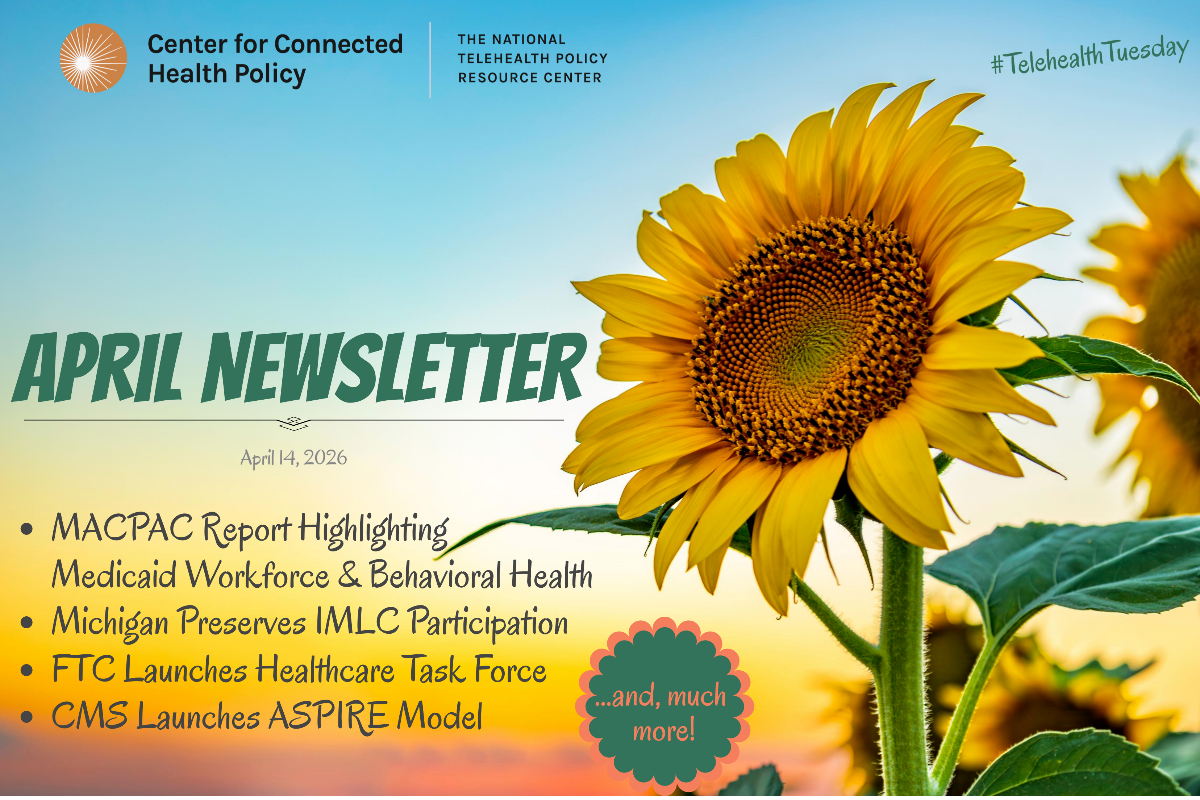
CCHP’s February Newsletter is here! This month’s newsletter includes the following topics – Medicare Telehealth Waivers Extended Through 2027; DEA Extends Telehealth Prescribing Waiver Through 2026; Key Telehealth Policy Developments from CCHP’s Latest 50-State Review; CMS Report Highlights Medicare Telehealth Utilization Trends Through 2025; Senate HELP Committee Holds Hearing on Medication Abortion; CMS Awards Year 1 Funding Under $50B Rural Health Transformation Program; JD Supra Analysis: DOJ Enforcement Risks for Telehealth Platforms; Evidence Supports Telehealth for Preoperative Evaluation.

Newsletter

Update on Medicare Telehealth Waivers & CCHP’s Sr. Policy Guru Shares Insights on Important New Findings & Trends

The Medicare telehealth waivers expired on January 30, 2026; however, Congress is working on passing an agreement made last week that would allow these flexibilities to be extended to the end of 2027 through H.R. 7148, the Consolidated Appropriations Act, 2026. While we are in the midst of a brief lapse in the telehealth waivers and a partial shutdown of the federal government, the House is trying to pass the bill and will potentially take it up today. As with the last shutdown, the new language is expected to apply retroactively and cover the lapse period.  This deal will restore continuity to Medicare telehealth coverage and avoid a prolonged return to permanent, pre-pandemic policy. The extension will maintain key flexibilities, including expanded originating sites, geographic waivers, and eligibility for certain providers that would otherwise be unavailable under permanent Medicare telehealth rules.  Details on which policies are affected were outlined in CCHP’s newsletter from last week.